


.jpg)

What are Fats?
Fats are a sort of supplement that you get from your eating routine. It is fundamental to eat a few fats, however it is likewise unsafe to eat excessively.
The fats you eat give your body energy that it needs to appropriately work. During exercise, your body utilizes calories from sugars you have eaten. Be that as it may, following 20 minutes, practice relies somewhat upon calories from fat to make a big difference for you.
You likewise need fat to keep your skin and hair sound and assist you with retaining nutrients A, D, E, and K, which are called fat-solvent nutrients. Fat additionally fills your fat cells and protects your body to assist with keeping you warm.
The fats your body gets from your food give your body fundamental unsaturated fats called linoleic and linolenic corrosive. They are classified "fundamental" on the grounds that your body can't make them itself, or work without them. Your body needs them for mental health, controlling aggravation, and blood coagulating.
Fat has 9 calories for every gram, multiple times the quantity of calories in starches and protein, which each have 4 calories for each gram.
All fats are comprised of soaked and unsaturated fats. Fats are called soaked or unsaturated relying upon the amount of each kind of unsaturated fat they contain.
Kinds of fat
Immersed fats raise your LDL (terrible) cholesterol level. A high LDL cholesterol level endangers you for cardiovascular failure, stroke, and other significant medical conditions. You ought to stay away from or limit food sources that are high in soaked fats.
Keep immersed fats to under 6% of your complete everyday calories.
Food varieties with a great deal of immersed fats are creature items, for example, spread, cheddar, entire milk, frozen yogurt, cream, and greasy meats.
A few vegetable oils, like coconut, endlessly palm piece oil, likewise contain soaked fats. These fats are strong at room temperature.
An eating routine high in soaked fat increments cholesterol development in your corridors (veins). Cholesterol is a delicate, waxy substance that can cause obstructed, or impeded, supply routes.
Eating unsaturated fats rather than immersed fats can assist with bringing down your LDL cholesterol. Most vegetable oils that are fluid at room temperature have unsaturated fats. There are two sorts of unsaturated fats:
Monounsaturated fats, which incorporate olive and canola oil
Polyunsaturated fats, which incorporate safflower, sunflower, corn, and soy oil
Trans unsaturated fats are undesirable fats that structure when vegetable oil goes through a cycle called hydrogenation. This leads the fat to solidify and become strong at room temperature. Hydrogenated fats, or "trans fats," are in many cases used to keep a few food sources new for quite a while.
Trans fats are likewise utilized for cooking in certain eateries. They can bring LDL cholesterol steps up in your blood. They can likewise bring down your HDL (great) cholesterol levels.
Trans fats are known to have destructive wellbeing impacts. Specialists are attempting to restrict how much trans fats utilized in bundled food varieties and eateries.
You ought to stay away from food varieties made with hydrogenated and somewhat hydrogenated oils (like hard spread and margarine). They contain elevated degrees of trans unsaturated fats.
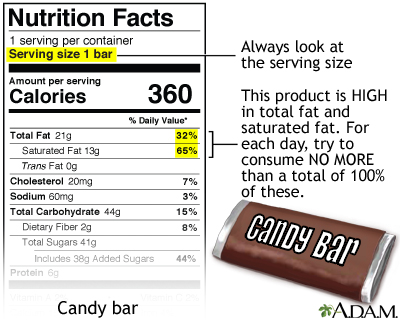
It is critical to peruse nourishment marks on food sources. This will assist you with understanding what sorts of fats, and how much, your food contains.
Food Name Guide for Treats
Chat with your medical care supplier about how to eliminate how much fat you eat. Your supplier can allude you to a dietitian who can assist you with diving more deeply into food sources and assist you with arranging a sound eating routine. Ensure you have your cholesterol levels checked by a timetable your supplier gives you.
Elective Names
Cholesterol - dietary fats; Hyperlipidemia - dietary fats; computer aided design - dietary fats; Coronary vein sickness - dietary fats; Coronary illness - dietary fats; Anticipation - dietary fats; Cardiovascular infection - dietary fats; Fringe course sickness - dietary fats; Stroke - dietary fats; Atherosclerosis - dietary fats
.
Chat with your medical care supplier about how to eliminate how much fat you eat. Your supplier can allude you to a dietitian who can assist you with more deeply studying food sources and assist you with arranging a sound eating routine. Ensure you have your cholesterol levels checked by a timetable your supplier gives you.
Elective Names
Cholesterol - dietary fats; Hyperlipidemia - dietary fats; computer aided design - dietary fats; Coronary conduit infection - dietary fats; Coronary illness - dietary fats; Anticipation - dietary fats; Cardiovascular sickness - dietary fats; Fringe corridor infection - dietary fats; Stroke - dietary fats; Atherosclerosis - dietary fats
.
.
.


.jpg)


No comments:
Post a Comment